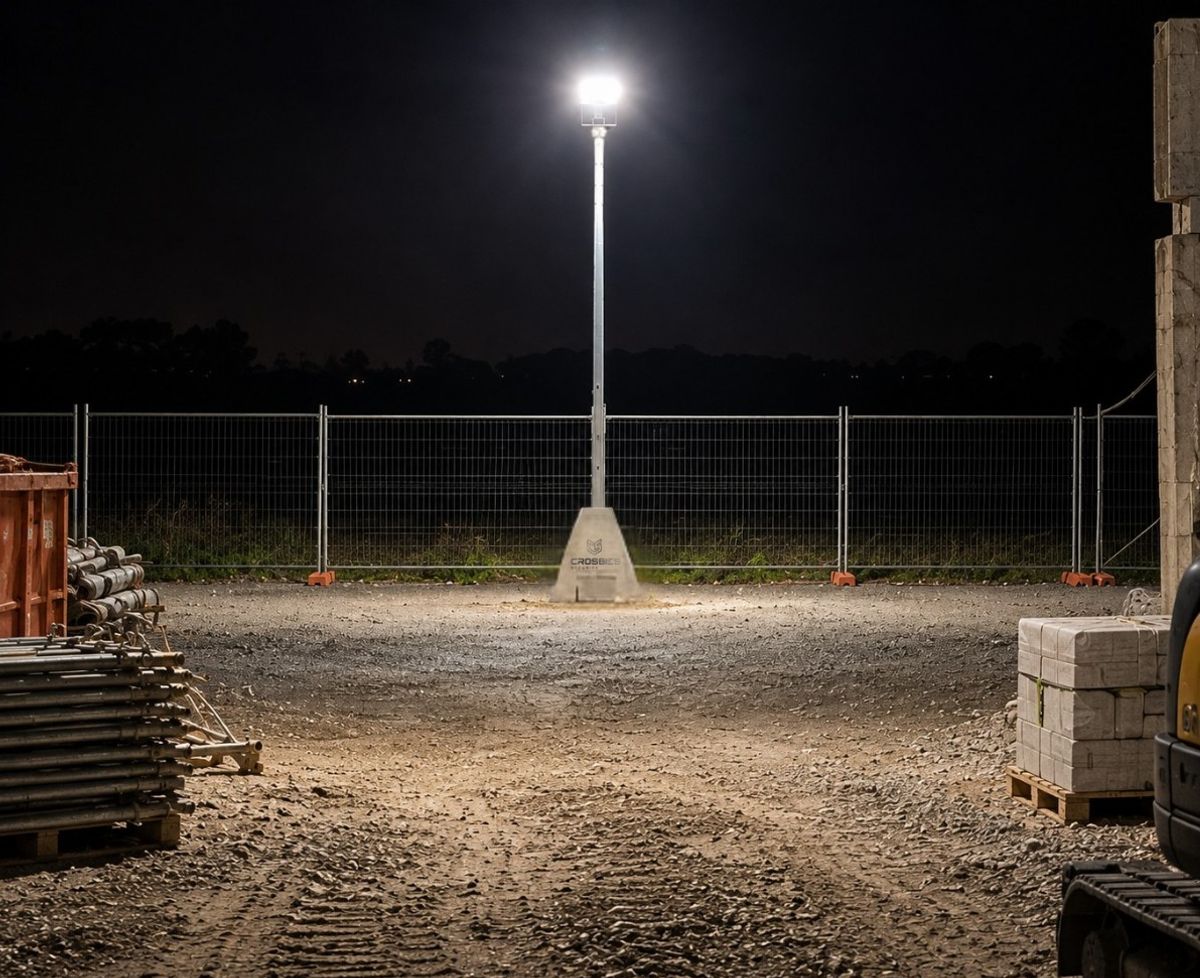
Solar lighting deters intruders on its own and, paired with CCTV, extends how far your cameras can effectively see at night. Most camera infrared (IR) only lights up a limited zone close to the lens. Add a solar lighting tower, and you push useful visibility, and AI detection, much further across the site, without mains power or ongoing electricity costs.
If you manage security for a construction or infrastructure site, you already know the pattern: incidents happen at night, in the dark corners cameras struggle to see clearly. A camera can only act on what it can actually make out, and most night vision is more limited than people assume.
Solar lighting fixes two problems at once. It puts intruders under a spotlight before they get near your assets, and it gives your cameras and AI analytics a much better picture to work with. For sites that are remote, temporary, or off-grid, exactly the kind of sites we work on every day, that combination matters more than most people realise.
The problem with relying on IR alone
Every CCTV camera with night vision uses infrared illumination to see in the dark. It works, but it has a ceiling. IR is built into the camera housing, so its reach is fixed and relatively short, even a high-grade camera like the ones we deploy typically reaches around 30–40 metres, depending on the environment.
Large objects in the foreground, stacked materials, parked machinery, can cause IR flare, scattering light back at the lens. Everything in front of the object becomes brighter and clearer, but anything behind it is effectively lost. Once someone is outside the effective zone, the camera is recording dark, grainy footage that's hard for AI, or a human reviewing it later, to make sense of.
That's a real gap on a construction site. Stockpiled materials, machinery compounds, and site boundaries are often spread well beyond where a single camera's IR can do its job properly.
Lighting isn't just a deterrent, it's a force multiplier for your camera system.
How solar lighting extends what your cameras can actually see
A solar-powered LED lighting tower throws daylight-quality illumination (6000K colour temperature) well past the reach of a camera's built-in IR. With proper lighting on a scene:
- Image quality improves significantly across the full frame, giving AI analytics far more detail to work with, including in the corners where light naturally falls off first.
- Detection and classification, person versus vehicle versus animal, gets more accurate, which means fewer false alerts and faster, more confident responses from our monitoring team.
- Footage holds up as usable evidence. Well-lit, detailed video stands up in after-action reports, insurance claims, and police follow-up in a way that dark, grainy IR footage often can't.
Lighting and cameras aren't separate line items. Lighting is what lets your camera system perform the way it's meant to, especially across larger or more exposed sites.
Light is a deterrent in its own right
Before a camera even needs to detect anything, light does a lot of the work. Most people looking to access a site without permission are relying on darkness to go unnoticed. Remove that, and you remove a big part of the opportunity.
A well-lit site signals that it's being actively managed and watched, which is exactly the message you want to send. Combined with verbal warning systems and 24/7 monitoring, lighting is often the first line of defence, not just a backup to cameras.
Built for sites without mains power
Most of the sites our customers run security on don't have reliable power: new builds, remote infrastructure projects, solar farms, or short-term sites where running power for lighting just isn't practical. Solar lighting towers solve that without compromise:
- No mains connection required, deploy anywhere on site that gets sunlight.
- LiFePO4 batteries store enough charge to keep running through New Zealand's variable weather, including overcast stretches.
- IP65-rated enclosures built to handle real construction site conditions.
- Available in 60W and 120W options, with customisable settings depending on what the site needs.
- No electricity bills, no generator running costs, no diesel to manage.
The cost-of-ownership argument
Cheaper, low-spec lighting and camera setups can look attractive on price. But the real cost of a security system isn't the upfront spend, it's what happens when an incident occurs and the footage isn't good enough to act on, or the system simply didn't pick it up in time.
Better lighting means better footage, more accurate detection, and fewer missed events. Across our network, sites running our solar towers see an 85% deterrence rate, with intruder events detected, police attended, and arrests made on camera. That's the return that matters: fewer incidents, less downtime, and less disruption to your programme.
Frequently asked questions
Does solar lighting help with health and safety, not just security?
Yes. Many incidents and near-misses on site happen during early morning starts or late finishes when natural light is poor. Good lighting around access points, walkways, and work areas helps your team see hazards clearly, which is as much a health and safety benefit as it is a security one.
Does solar lighting work through a New Zealand winter or extended cloudy periods?
Yes. Solar panels and LiFePO4 battery storage are sized to handle reduced sunlight, and our team configures each setup for the site's specific conditions and usage needs.
Can solar lighting be added to an existing camera setup?
Yes. Our lighting towers are standalone units, deployed alongside your Gen-3 or Gen-2 CCTV towers or Rapid Deployment Units as a complementary layer. They're positioned to light up the areas your cameras cover, making the existing system more effective without any physical integration required.
Does better lighting really improve AI detection accuracy?
Yes. AI analytics rely on image clarity to tell the difference between a person, a vehicle, and background movement. Well-lit, colour footage gives the AI far more to work with than IR alone, which means more reliable alerts and fewer false positives.